

Sofgen Computer Consultants (P) Ltd. is an innovative ERP/IT Solutions and Services Organization working since 1989.
ERP for Footwear Industry
Connecting Production, Materials and Business Decisions
Footwear businesses engage in several activities like managing different colours and sizes of a single style, procuring synthetic materials or leather, and handling the inventory. When these activities are recorded on separate spreadsheets, it may lead to confusion and poor decision making. But ERP for footwear industry brings all these activities to a unified system that can allow the management to have structured business information related to all these activities.
Understanding the Operational Reality of Footwear Manufacturing
Fulfilling material requirements is the first step in footwear manufacturing. Materials are required for different colours and sizes of the same style, and this is why the production and management teams need accurate information related to the specifications of different products. ERP integration smoothens the process of understanding material requirements for footwear businesses.
Where Footwear Manufacturers Commonly Face Operational Pressure
Diverse varieties of footwear is one of the biggest pressures for footwear businesses, because there are divergent colours and sizes of a single style. All the information related to such a diverse variety of products isn’t easy to manage. Thus, businesses increasingly depend on mutual reconciliation.
All materials like adhesives, soles, eyelets, or others need to be available at the same time, or else the production process is delayed. Reactive purchasing is, therefore, common among footwear businesses.
All production stages must be executed in a sequence, but when certain materials are unavailable at a particular stage, it can affect the whole production process.
Work-in-progress must be tracked effectively to know each stage of the production process. The teams must know what needs to be cut and what needs to be stitched, and this information is not available to the concerned teams in a structured way.
As there are different types of costs that footwear businesses incur, and these costs are not recorded in a structured way on a unified platform. Thus, a lack of inaccurate financial information leads to inefficient production activities.
Production records must contain information related to quality, which doesn’t usually happen in footwear businesses because of manual processes. Thus, management is unable to make timely decisions to keep the quality up to par.
A Representative Footwear Manufacturing Scenario
The sales team usually takes, records, and maintains orders for different types of footwear in a single system. The procurement team uses spreadsheets to record the relevant information. The production team prepares schedules and batches for the production of different types of footwear. The warehouse team keeps an eye on inventory. The finance team takes care of costs and records them separately.
Now, if the question is, “what are the products that can be produced and dispatched on time?”
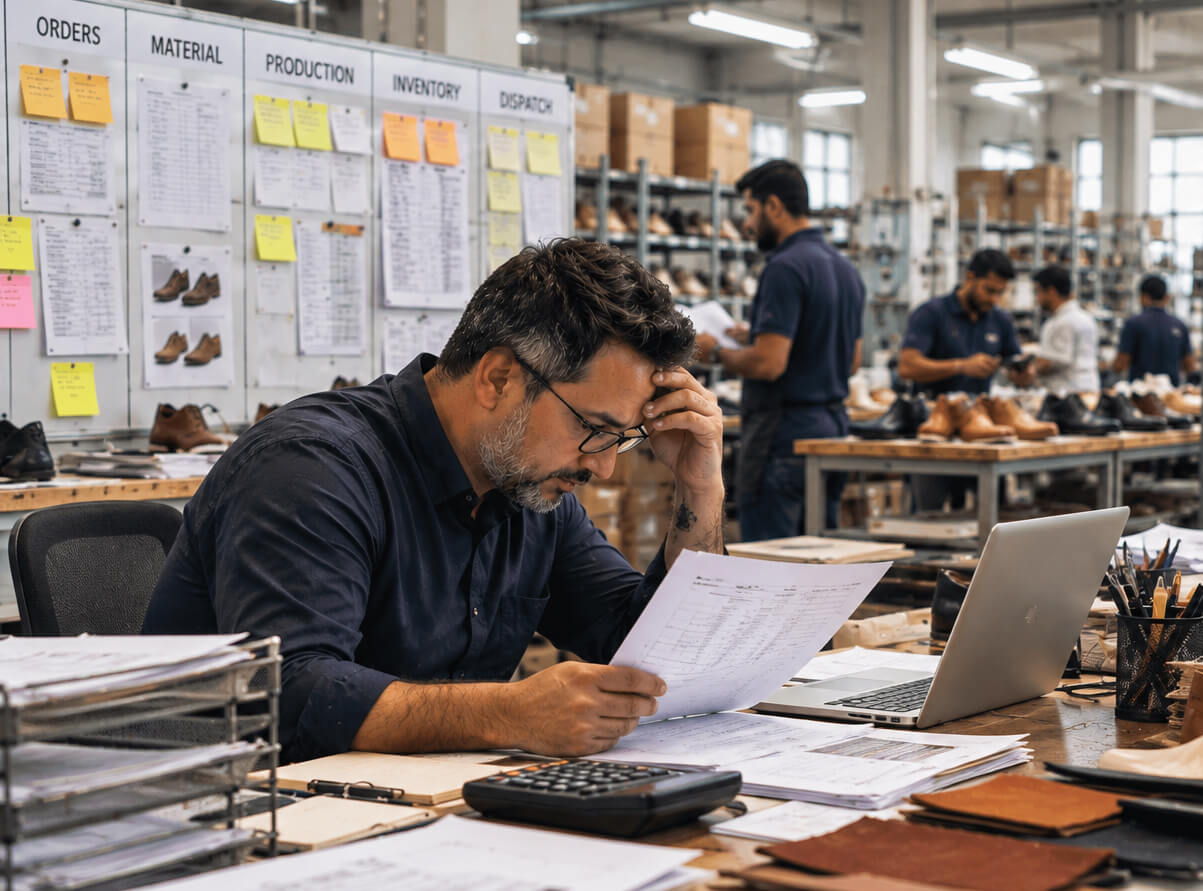
To answer this simple question, different departments need to check their records and spreadsheets because the information is not structured. The information is fragmented!
This is exactly where the role of ERP for footwear industry comes into play. ERP integration gives a unified platform to record the information related to different aspects of footwear businesses in a structured manner.
Why Traditional Systems Can Become Difficult as Footwear Operations Grow
Traditional systems can work well as long as a footwear business operates at a small scale. However, scaling up becomes challenging with traditional systems, because the list of products, colours, and sizes expands. Also, the production team cannot establish the link between material requirements, available stock, and pending orders. Manual reporting cannot smoothen this process to the desired extent. This is the main reason that ERP software for footwear manufacturing companies is the only solution for businesses that are planning to scale up.
ERP for Footwear Industry with Sofgen
Sofgen ERP integration can help footwear businesses smoothen their operational processes and enhance their efficiency. This is mainly because Sofgen can help business improve their:
Production planning
Sofgen ERP helps footwear businesses link production requirements, stock availability, and demand with one another.
Material management
It also helps footwear businesses better manage their available inventory.
Purchase management
It helps them establish smoother connection between information related to delivery requirements and purchase requirements.
Quality management
Footwear businesses are better able to review quality checks with Sofgen ERP.
Inventory and warehouse management
Sofgen ERP simplifies the process of handling the available materials.
Finance and costing
It helps footwear businesses record their financial information in a structured way.
Reporting
It helps in better and more accurate reporting of different operations.
Integration with e-com services
Sofgen integrates its ERP into the e-commerce activities of footwear businesses by connecting inventory management, order management, payment processes, delivery processes, and financial management on a single platform.
Apart from this, Sofgen also offers customisable options and on-premise deployment on the basis of the specific requirements of some footwear businesses.
ERP for Footwear Industry with Sofgen
| Capability | Problem | Sofgen ERP Benefit |
|---|---|---|
| Managing Varieties | Footwear businesses have to manage a diverse variety of products, which causes difficulty in reconciling production, stock, and order status. | It connects information related to different sizes and colours, making it easier for teams to work together. |
| Material Planning and BOM | There are typically different types of materials that footwear businesses need to manage like insole, lining, adhesives, and packaging materials. | It gives structured and well-connected information related to different material requirements. |
| Production Planning and Control | There needs to be a perfect sequence of production activities like cutting, stitching, and finishing. | It allows footwear businesses to schedule these productive activities more effectively. |
| Work-in-Progress | The management usually does not know the exact status of orders and batches under traditional systems. | It records information related to different stages of production, and thus the management can know the progress of all orders and batches. |
| Coordination with Suppliers | Footwear businesses face the problem of material shortages because of a lack of coordination with suppliers, which delays the production. | It enables better material planning, better inventory management, and smoother coordination with suppliers. |
| Better Quality Checks | Quality management is a constant challenge for footwear businesses because they have to execute large batches of production. | It incorporates information related to quality into the regular workflows, which allows the concerned teams to take corrective action on time. |
| Cost Management | Information related to finances is usually scattered, which makes it difficult to connect production costs, material usage, and operational expenses to one another. | It records the finances of a footwear business on a unified platform, which makes it easier for the concerned teams to better understand finances. |
ERP for Footwear Industry with Sofgen
| Capability | Problem | Sofgen ERP Benefit |
|---|---|---|
| Managing Varieties | Problem: Footwear businesses have to manage a diverse variety of products, which causes difficulty in reconciling production, stock, and order status. | Sofgen ERP benefit: It connects information related to different sizes and colours, making it easier for teams to work together. |
| Material Planning and BOM | Problem: There are typically different types of materials that footwear businesses need to manage like insole, lining, adhesives, and packaging materials. | Sofgen ERP benefit: It gives structured and well-connected information related to different material requirements. |
| Production Planning and Control | Problem: There needs to be a perfect sequence of production activities like cutting, stitching, and finishing. | Sofgen ERP benefit: It allows footwear businesses to schedule these productive activities more effectively. |
| Work-in-Progress | Problem: The management usually does not know the exact status of orders and batches under traditional systems. | Sofgen ERP benefit: It records information related to different stages of production, and thus the management can know the progress of all orders and batches. |
| Coordination with Suppliers | Problem: Footwear businesses face the problem of material shortages because of a lack of coordination with suppliers, which delays the production. | Sofgen ERP benefit: It enables better material planning, better inventory management, and smoother coordination with suppliers. |
| Better Quality Checks | Problem: Quality management is a constant challenge for footwear businesses because they have to execute large batches of production. | Sofgen ERP benefit: It incorporates information related to quality into the regular workflows, which allows the concerned teams to take corrective action on time. |
| Cost Management | Problem: Information related to finances is usually scattered, which makes it difficult to connect production costs, material usage, and operational expenses to one another. | Sofgen ERP benefit: It records the finances of a footwear business on a unified platform, which makes it easier for the concerned teams to better understand finances. |
From Factory Data to Management Decisions
Sofgen ERP helps different teams and departments make better decisions because:
It gives the Plant Head the required information on material availability, pending orders, production status, and work-in-progress.
It allows the Procurement Head to better understand stock positions, material requirements, and supplier commitments.
It makes it easier for the CFO to understand the flow of the capital, material costs, and inventory status.
It gives the Sales Head the accurate information on order status, dispatch status, and production progress.
It simplifies it for the management to engage in cost analysis, key performance indicators, and production progress.
What a Connected ERP Environment Can Help Improve
ERP software for footwear manufacturers can help footwear companies get:
Smoother flow of operations
Better financial reporting
More efficient inventory management
Better material coordination
More efficient process for procurement
A better overall system for scaling up operations
Why Consider Sofgen for Footwear Manufacturing ERP?
Sofgen ERP for footwear industry is extremely useful, because it allows footwear manufacturers to better manage their material requirements. Plus, once Sofgen ERP is integrated into the operations of footwear businesses, it can help them schedule and execute their operations more effectively and record their progress and business information more accurately. Besides this, as Sofgen also offers customisable ERP solutions, footwear businesses need not worry about changing their entire business models.
Build an ERP Strategy Around Your Footwear Business
Sofgen does not force footwear businesses into adopting a generic software model. Instead, it first understands your business model, organisational objectives, short- and long-term goals.
After that, it identifies the best approach that fits your current business model and then incorporates ERP into your operations.